

Cybersecurity and Business Strategy: Aligning for Success
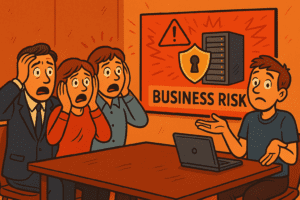
We really need to get past this idea that cybersecurity is a cost centre. It is not. It is an asset protection function. If any part of your business relies on revenue, reputation, data, or uptime, congratulations, you have already built a business that depends on cybersecurity. You have made the decision that it matters. The problem is, you may not have budgeted for that decision.
Cybersecurity is fundamentally about protecting the assets, tools, and resources that enable the business to grow. It is not about buying the shiny new widget that makes your IT team grin like a kid at Christmas. IT and cyber are cousins, not twins. This is a business problem, not an IT problem.
If your organisation does not have a cohesive security strategy, what you have is wishful thinking dressed up as planning. You cannot talk about market expansion, digital transformation, improved onboarding, automation, AI, or scaling, and pretend threats do not exist. If cyber is not embedded in your strategic roadmap, you are running a business held together with hopes, dreams, and a very generous prayer. It rarely survives first contact with reality.
You are also making an overconfident assumption that the bad actors will play nice. They will not. The more recognition your business gains, the more attention you attract from the people you would prefer to never meet. Size does not matter here. Every organisation is a target, whether you like it or not.
Cyber risk is business risk. Treat it like every other risk category. It sits right alongside financial, legal, operational, and contractual risk. Yet for some reason, many organisations still treat it like a mysterious green goblin living in the server room. Gremlins belonged in the 80s. That approach barely worked then and it certainly does not work now.
Aligning cybersecurity with business strategy starts with acknowledging the actual commercial impact of an incident. Revenue. Trust. Contracts. Valuation. This is not just an IT outage. It is a business event.
The reason cybersecurity adds value is because it enables growth by removing friction. When it is done properly, cybersecurity clears the path for innovation. Clear governance means faster decision making. Defined risk tolerance means projects get approved faster. Strong security foundations mean fewer surprises when you hit production. It is incredible how quickly an organisation can accelerate when it is not constantly firefighting self-inflicted security issues.
Cybersecurity maturity is now a competitive advantage. Customers, investors, partners, and regulators increasingly choose to work with organisations that take security seriously. Strong cybersecurity signals reliability. Weak cybersecurity signals risk. In tenders and modern supply chains, those signals matter far more than many executives realise. Major projects are already pushing mandatory cybersecurity requirements down into their tier three vendors. That is where most of the SMB market operates. This is not a theoretical risk. This is already happening.
When cybersecurity is aligned with strategy, it prevents cost blowouts later. Reactive security is always more expensive. When decisions are made early, costs are predictable, manageable, and aligned to real risk rather than whatever happened to catch fire this week. Leave it until after something goes pop and suddenly you are budgeting for PR firms, forensic teams, legal fees, overtime, customer churn, and reputation damage. And as the statistics consistently show, most organisations that experience a major data breach end up replacing at least 30 percent of their staff within the following year.
Leadership owns cybersecurity risk, not IT. Cyber risk sits with the executive team and the board because it impacts strategic outcomes. Not because a firewall rule needs updating. When boards and CEOs lead these conversations, the organisation moves from compliance driven security to value driven security. That is when cybersecurity starts aligning with long term commercial goals.
It is a business risk. Not an IT risk.
If you want to understand how your organisation could or should be implementing, managing, or maintaining a cybersecurity system, framework, or governance process, reach out. Always happy to have a conversation and take you through what needs to be done.


Leave a Reply
Want to join the discussion?Feel free to contribute!